


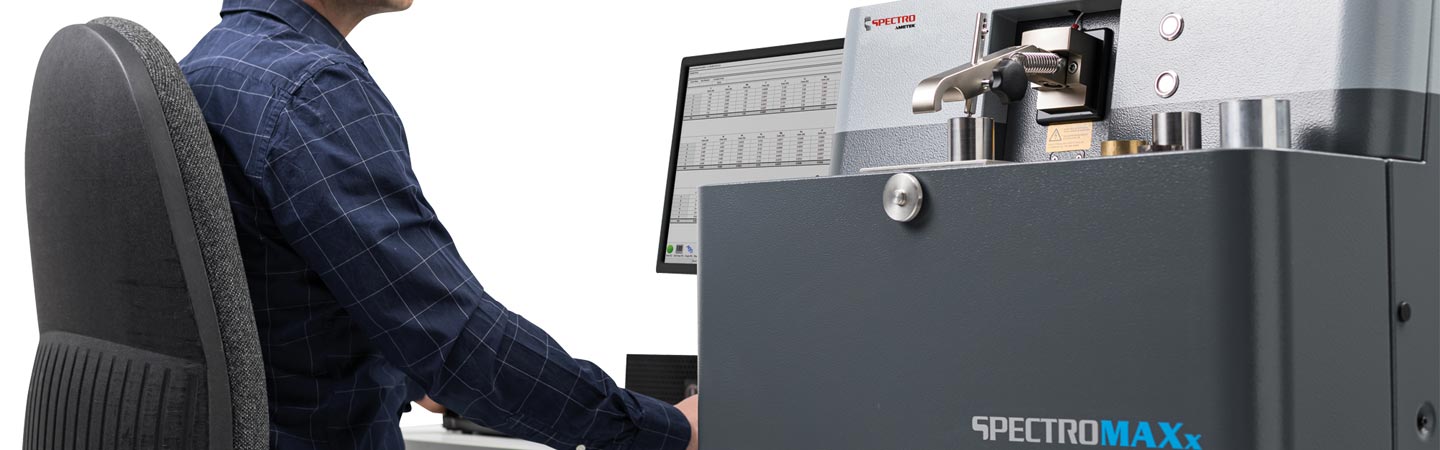
The stationary OES spectrometer SPECTROMAXx we use is a device for chemical analysis and is used to display the emission spectrum of chemical substances. The main use is in the rapid analysis of metal alloys.
It works on the principle of optical emission spectrometry (arc-spark OES or spark OES).
In the spark stand, sample material is vaporized by an arc or spark discharge and the released atoms and ions are stimulated to emit radiation. It can measure specimens of a certain geometry and size.
If the sample material (component, sheet metal, rods, etc.) does not meet the specifications in this regard, the material must be processed in the context of sample preparation to meet the device requirements, often even poured into a suitable mold. Due to the intensive preparation of the sample and the direct coupling of the spark stand to the spectrometer optics, on the other hand, extremely precise analysis of all alloying elements from traces to high levels is possible.
Determination of the chemical composition of metals – possible uses and advantages
The main areas of application for optical emission spectrometry are incoming and outgoing goods inspections in the metal industry and material testing. Foundries, steel, copper or aluminum manufacturers as well as metal processors in the automotive, aviation or household appliance industries use our OES analyzes for process and quality control.
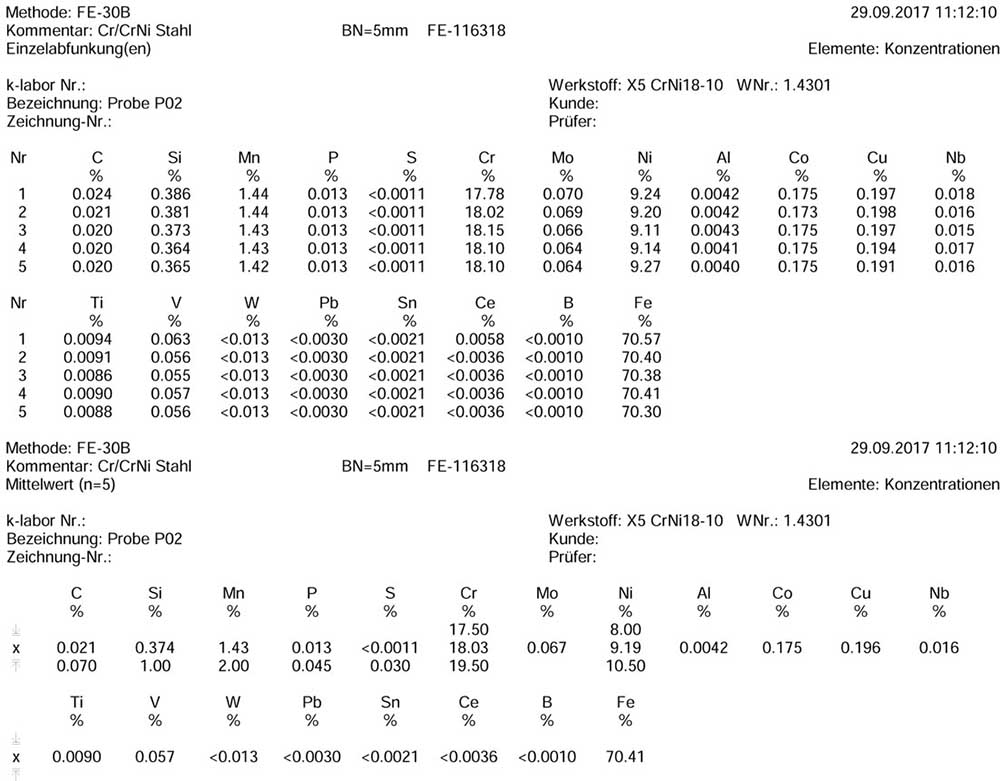
Example: Determination of the chemical composition of a sheet metal using an OES spectrometer
In the OES analysis of low or high alloy steels, for example, the weight percentages of the elements C, Si, Mn, P, S, Cr, Mo, Ni, Al, Co, Cu, Nb, Ti, V, W, Pb , Sn, Ce, B, Fe can be determined and metals can be reliably named.
FAQ
A flat, metallically bright surface of at least 10 × 10 mm and approx. 5 mm thickness. Surface treatments (zinc, coatings) must be removed beforehand or we grind them off.
As standard within 3 working days, express on the same day possible by arrangement.
Dekra Automobil GmbH, Unidekstraße 5, 75015 Bretten,
with the sample accompanying form (download area). Ideally with an indication of the suspected material group (steel, stainless steel, aluminium, Cu alloy).
Yes, spectral analysis for iron-, aluminium-, copper- and nickel-based alloys is DAkkS-accredited.
Yes, OES analysis is the standard material certificate for incoming goods inspection. The test report can be enclosed with a 3.1 material certificate (EN 10204).
Main alloying elements are determined with an uncertainty of less than 0.001% absolute, trace elements depending on the element. Differentiation of similar materials (e.g. 1.4301 vs. 1.4307) is reliably possible.