



The salt spray test is well suited for comparing materials and corrosion protection systems with one another. It is used as a test method for the quality control of coatings in all areas of industry.
Salt spray test according to DIN EN ISO 9227 (NSS test)
With the help of a salt spray test according to DIN EN ISO 9227 (NSS test), the corrosion resistance of a material or an anti-corrosion coating on it can in principle be determined.
During the test, the test items are in a chamber in which a 5% saline solution with a controlled pH value is continuously nebulized at a temperature of 35 ° C. The mist is deposited on the test objects and covers them with a corrosive film of salt water.
Exposure times are for example: 96 hours, 240 hours, 480 hours, 720 hours or other test durations. The test durations are based on the expected corrosion resistance of the tested material system.
After completion of the salt spray test, the test items are rinsed with deionized water in order to remove loosely adhering corrosion products. The corrosion attack on the tested material system is then assessed visually or using electrical and microscopic methods.
Carrying out a salt spray test according to DIN EN ISO 9227
The components / test items / samples to be tested are placed in the salt spray chamber. We test with a white chamber, type SC KWT 450, with a test space of 480 liters, a maximum load of 100 kg and a brine storage tank of 180 liters.
The parts to be tested are distributed in such a way that no condensate can drip onto or touch other test objects. Sheets and other parts (e.g. screws) must be positioned at an angle (approx. 20 °) from the vertical. The following parameters must be observed in the salt spray test with NaCl solution in accordance with DIN EN ISO 9227:
- pH 6.5 to 7.2;
- Concentration of the NaCl solution 50 ± 5 g / l
- Chamber temperature 35 ° C ± 2 ° C
- Overpressure at the nebulization nozzle 0.7 to 1.4 bar
- condensed volume of the sprayed solution 1 to 2 mL per hour
After the salt spray test is complete, the tested materials are rinsed with deionized water to remove loosely adhering corrosion particles. The degree of corrosion on the tested material is then assessed and recorded visually or using electrical and microscopic methods. You will then immediately receive a digital test report from us by email.
Carrying out a salt spray test according to DIN EN ISO 9227 (NSS test) on various pipe qualities
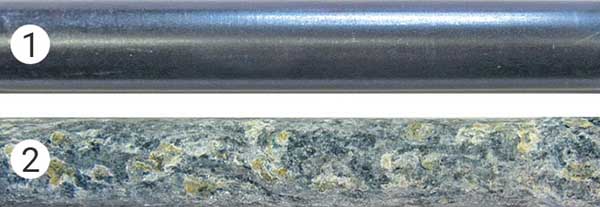
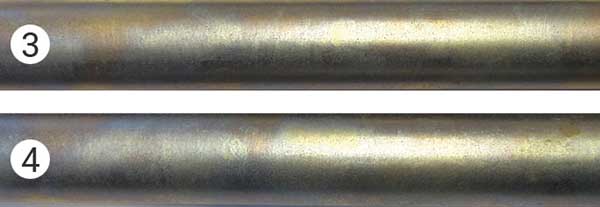
FAQ
Classically metallic materials with and without coating – i.e. unalloyed and alloyed steels, galvanised surfaces, aluminium, zinc die-cast, brass as well as electroplated coatings (Zn, Zn/Ni, Cr). Coated plastic parts with a metallic surface (e.g. electroplated trim parts) are also tested. Precious metals and certain stainless steels often do not yield any meaningful result in the salt spray test.
Typical test durations are 24, 48, 96, 240, 480, 720 and 1,000 hours in accordance with DIN EN ISO 9227 NSS. The duration depends on the protective system: galvanised steel usually 96–240 h, high-quality Zn/Ni systems 720–1,000 h, automotive exterior components frequently 480 h or more.
Base and white rust coverage are assessed in accordance with DIN EN ISO 10289, creepage at scribed areas in accordance with ISO 4628-8, blistering in accordance with ISO 4628-2 as well as visual assessment. The ratio of rusted to undamaged surface area is documented.
Shipping to
Dekra Automobil GmbH, Unidekstraße 5, 75015 Bretten.
Please enclose the sample accompanying form from the download area. Do not touch the test surface with bare fingers; edge protection (e.g. with adhesive tape) should only be applied by prior arrangement, as this may be part of the test specification.
Yes, DIN EN ISO 9227 (NSS, AASS, CASS) is part of our DAkkS-accredited scope of testing.
Yes, provided that the statement names the tested standard (ISO 9227 NSS), the test duration and the assessment criterion. Purely blanket “corrosion-resistant” statements are not permissible – we are happy to support you with a correct wording.