


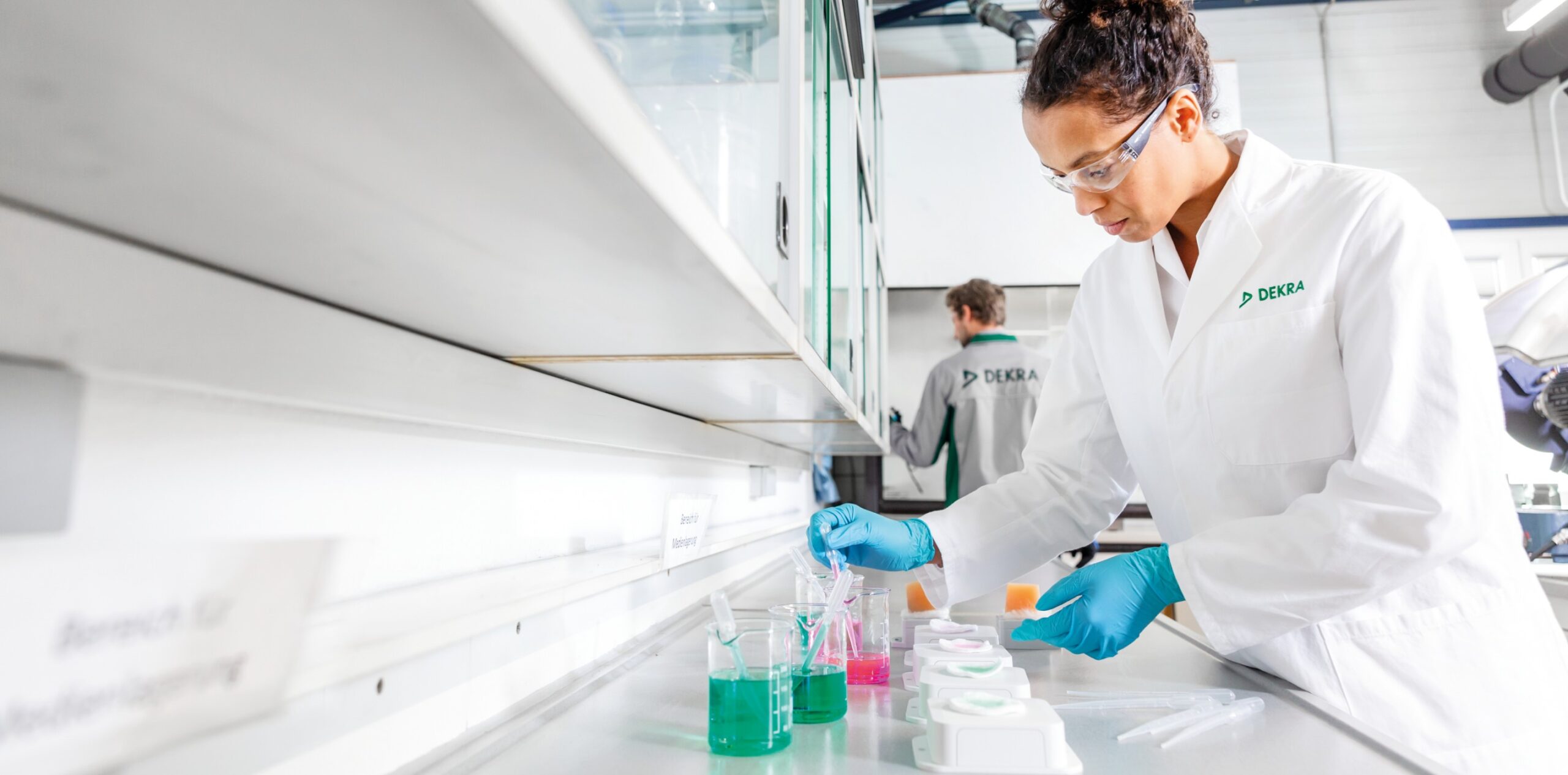
Chemical resistance testing in accordance with DIN EN ISO 2812 and OEM specifications
The resistance of materials to chemicals is decisive for their suitability in demanding areas of application – whether in vehicle interiors, mechanical engineering or packaging with media contact. DEKRA tests plastics, paints, seals, films, textiles and coatings for their resistance to media under realistic conditions.
Typical test media:
- Acids (e.g. hydrochloric acid, citric acid)
- Bases and alkaline cleaning agents
- Ethanol, isopropanol and other alcohols
- Fuels and fuels (e.g. diesel, AdBlue, brake fluid, windshield cleaner)
- Cosmetics, sunscreens, skin care products
- Industrial cleaning agents and disinfectants
Test method for chemical resistance:
Our tests are carried out in accordance with DIN EN ISO 2812 (parts 1-4) and customer-specific specifications of the automotive and packaging industry.
Among other things, we offer
- Drop tests: defined quantities of test media are applied to the surface and evaluated on a time-controlled basis
- Full immersion: complete immersion tests of test specimens in the medium at defined temperatures and times
- Immersion with absorbent media (e.g. filter paper, cotton fleece): simulates longer exposure times or residual exposure under real pressure
- Tests under mechanical preload (stress crack tests) to evaluate crack formation in accordance with DIN EN ISO 22088
- Conditioning before and after the test: e.g. storage at 23 °C / 50 % rH, climate chamber, heating cabinet
Evaluation criteria:
After exposure to the test media, changes such as:
- Color change, loss of gloss, swelling, blistering, cracking or flaking
- Loss of mechanical properties (e.g. breaking strength, elasticity)
- Change in mass or dimensions
are documented and evaluated according to standard specifications or customer specifications.
Fields of application:
Our chemical resistance tests are used in:
- Automotive (interior parts, engine components, housings, hoses)
- Medical and laboratory technology
- Packaging with food or chemical contact
- Household appliances, electronics, coatings and surfaces
You can rely on our experience in chemical resistance testing.
We support you with material comparisons, release tests and damage analyses – quickly, in accordance with standards and with reliable documentation.
FAQ
Plate-shaped samples 50 × 50 mm or tensile bars – at least 3 samples per medium and evaluation time. Original components are possible if a reference area remains unexposed.
Standard times 24 h / 168 h / 672 h (28 days). Depending on the programme 2 days to 6 weeks; for long-term resistance, up to 12 weeks.
Dekra Automobil GmbH, Unidekstraße 5, 75015 Bretten. Please enclose the sample accompanying form (download area) as well as safety data sheets of the test media.
Yes, ISO 175, ISO 22088 and a large number of customer-specific lists (e.g. disinfectant tests) are DAkkS-accredited.
Yes, with mention of the medium, concentration, exposure time and assessment criterion. Blanket statements should be avoided.
Change in mass, change in dimensions, visual assessment (swelling, discolouration, cracking) as well as residual mechanical values (tensile strength, elongation at break).