


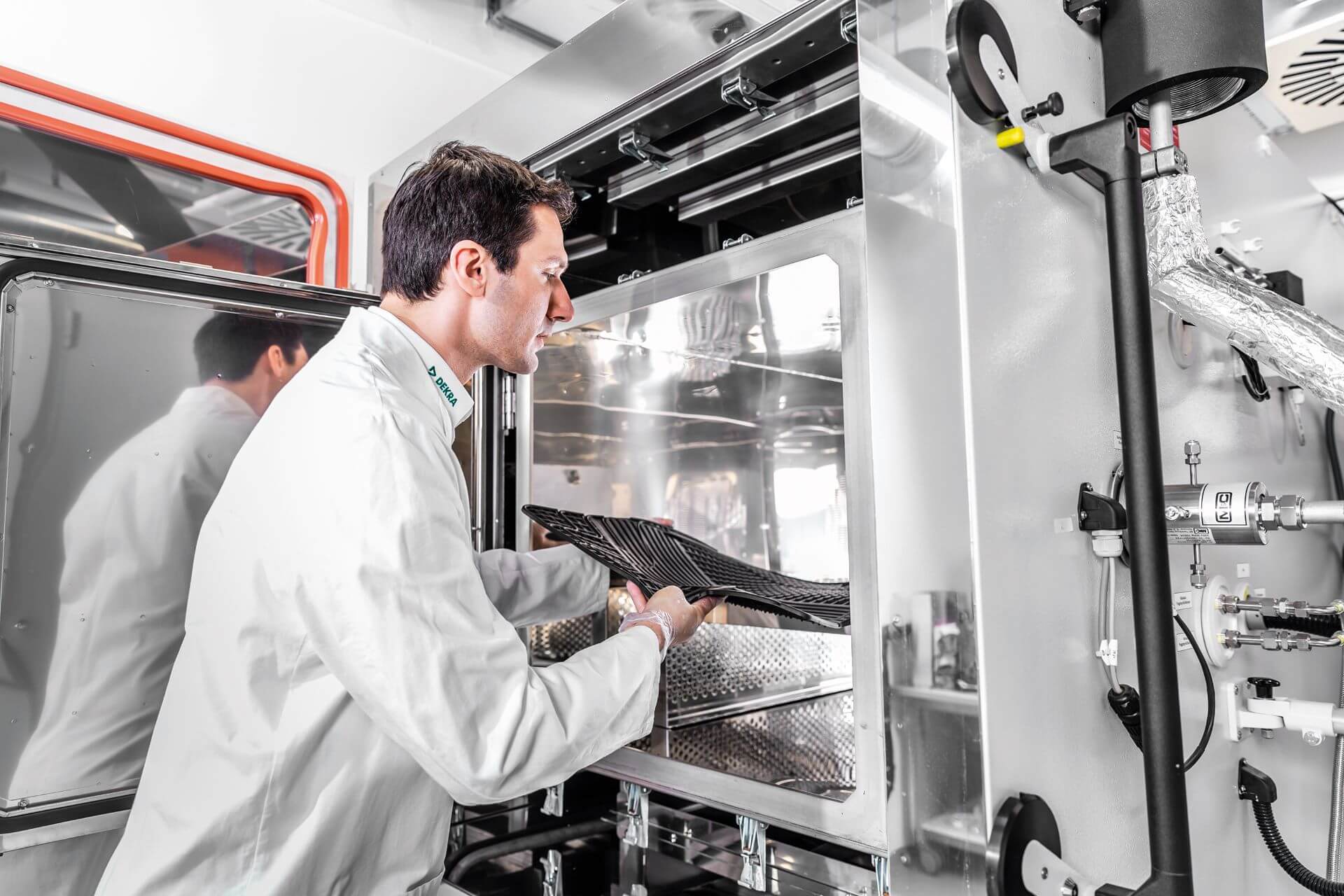
Parts, assemblies or technical products are exposed to a large number of environmental influences during their service life, which have a greater or lesser effect on the function and / or appearance of the component and possibly reduce the service life.
In our climate tests, we simulate the long-term behavior of these parts under severe external conditions in order to uncover weak points and to avoid subsequent damage and complaints.
The automotive industry, for example, has developed climate change tests for its products that it markets worldwide, which are characterized by the fact that salt spray phases alternate with phases of high or low temperature, high and low humidity and periods of rest. These variations in salt concentration, air humidity and temperature cause the corrosion environment on the material / component to change again and again.
Our services at a glance:
- Climate change test according to PV 1200 / PV2005, PR 303.5, DBL 8465 (VW, BMW, Daimler)
- Climatic storage with moisture
- Thermal storage / temperature storage
- Cold storage down to -40 ° C
- Pressure storage and steam sterilization in the autoclave
- Hydrolysis storage
- Conditioning of PA components in demineralized water
- Conditioning in a normal climate (23 ° C, 50% rel. Humidity) in the climatic chamber
Climate change test according to PV 1200 / PV2005, PR 303.5, DBL 8465 (VW, BMW, Daimler)
The climate change test is carried out according to DIN, special programs or according to the manufacturer’s factory standards – with and without humidity control according to DIN EN 60068.
Examples from the automotive sector:
Daimler: DBL 5306.5.2 – Alternating tropical climate storage
BMW standard: Pr.303.4 – Climate change test
VW standard: PV1200; PV2005, PR 303.5, DBL 8465 (VW, BMW, Daimler)
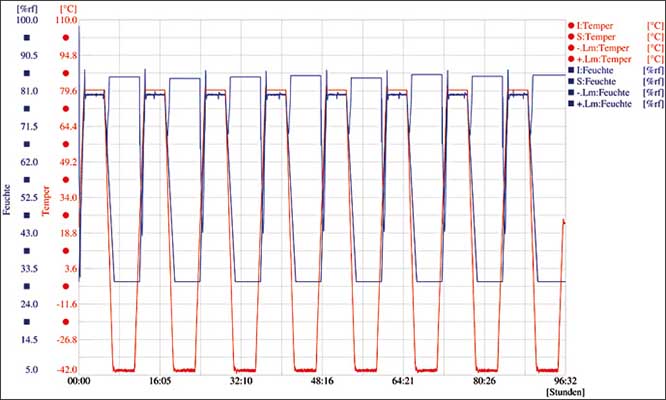
Heat and cold storage, temperature change test and their effects on materials
Polymer materials are subjected to a wide variety of conditions in a wide variety of applications. Since the properties of plastics are highly temperature-dependent and even low temperatures can lead to noticeable aging, it is important to check how the operating temperature affects the material selected for a specific application over a certain period of time.
Polymer materials are subject to aging, which can often be attributed to the effects of temperature. Tensions in the plastic, e.g. under the influence of heat, lead to a distortion of the component (deformation) and thus to problems with the accuracy of fit within an assembly.
If you want to determine aging values, the challenge is to keep the test duration as short as possible and still obtain meaningful results.
Particularly in the case of frequently changing temperatures as a result of temperature change tests, for example in metals and plastics – due to the different coefficients of thermal expansion of the materials – cracks or material peeling can occur.
An embrittlement of the material or a change in mechanical strength can also often be observed. For this reason, we recommend combining climatic storage with further checks of the product properties (hardness, strength, adhesive strength) before and after climatic storage.
FAQ
Original components or functional assemblies, ideally in the installed position. For electronics, please indicate whether the test is to be performed powered or unpowered.
In accordance with IEC 60068-2-14 usually 5–30 cycles between –40 °C and +85 °C, duration 3–21 days. Automotive cycles (e.g. VW 80000, PV 2005) run for 10–20 days.
Dekra Automobil GmbH, Unidekstraße 5, 75015 Bretten,
with the sample accompanying form (download area). State the desired cycle and functional test points.
Yes, IEC 60068-2-14, -30, -38 as well as the automotive cycles are DAkkS-accredited.
Yes, with a clear indication of the cycle, the temperature extremes and the number of cycles.
Functionality, tightness, mechanical integrity, solder joint quality (for electronics), visual changes and, if applicable, electrical parameters.